I've been reading The Accidental Tourist by Anne Tyler, in which Macon Leary, a travel guide writer, meets Muriel Pritchett, a dog trainer. Love ensues and ultimately succeeds, because this is a romance novel and people will cry for blood if love doesn't triumph.
In the novel, Macon and Muriel are almost opposites, just like Macon and his ex-wife Sarah. Macon is neat, fastidious (bonus points for vocab word), stolid, and does everything according to system, while Muriel is something of a "wild child." Sarah is actually more opposing in personality to Macon, with her messiness, tendency to distrust systems, and active personality.
What I don't get is this: why are opposites attracted to each other? Is it the tendency to be fascinated with the personality type you don't have? Is it some genetic thing, or instilled into us by society?
Actually, some opposites don't attract. There are probably some couples with the same interests and personalities. Still, this "opposites attract" thing is very interesting.
Showing posts with label book. Show all posts
Showing posts with label book. Show all posts
Friday, November 11, 2011

Tuesday, October 25, 2011
Aging and Death
I've been reading The Accidental Tourist by Anne Tyler, about Macon Leary, a travel guidebook writer who hates to travel. Macon has a wife, Sarah, who is his polar opposite; while Macon is uptight and fastidious, Sarah is messy and carefree. Their son, Ethan, was killed in a fast-food restaurant shooting. The book tells the tale of how Macon, after divorcing Sarah, finds new love in Muriel Pritchett, a dog trainer several years his junior. In particular, I found this passage at the very end captivating:
"And if dead people aged, wouldn't it be a comfort? To think of Ethan growing up in heaven - fourteen years old now instead of twelve - eased the grief a little. Oh, it was their immunity to time that made the dead so heartbreaking. (Look at the husband who dies young, the wife aging on without him; how sad to imagine the husband coming back to find her so changed.) Macon gazed out the cab window, considering the notion in his mind. He felt a kind of inner rush, a racing forward. The real adventure, he thought, is the flow of time; it's as much adventure as anyone could wish. And if he pictured Ethan still part of that flow - in some other place, however unreachable - he believed he might be able to bear it after all."
This passage was worthy of being mentioned in that it made me think of the people I've known that have passed away. (Fortunately, they number only a few.) I thought of my grandmother with whom I lived for four years, a grandfather and an uncle I hardly knew, and a great-grandmother, of whom I've never seen the face. Like the passage says, it seems that these people I knew stopped aging the moment they died. Their faces, some half-formed and others clear as day, remain frozen in time in my memory.
Then, I thought to myself, how would things be different if I knew that they continued aging somewhere, albeit somewhere unreachable, foreign? If stillborn infants could live on, cry, laugh, go through childhood, and rule the world? It would be somewhat comforting to the bereaved, I imagine.
"And if dead people aged, wouldn't it be a comfort? To think of Ethan growing up in heaven - fourteen years old now instead of twelve - eased the grief a little. Oh, it was their immunity to time that made the dead so heartbreaking. (Look at the husband who dies young, the wife aging on without him; how sad to imagine the husband coming back to find her so changed.) Macon gazed out the cab window, considering the notion in his mind. He felt a kind of inner rush, a racing forward. The real adventure, he thought, is the flow of time; it's as much adventure as anyone could wish. And if he pictured Ethan still part of that flow - in some other place, however unreachable - he believed he might be able to bear it after all."
This passage was worthy of being mentioned in that it made me think of the people I've known that have passed away. (Fortunately, they number only a few.) I thought of my grandmother with whom I lived for four years, a grandfather and an uncle I hardly knew, and a great-grandmother, of whom I've never seen the face. Like the passage says, it seems that these people I knew stopped aging the moment they died. Their faces, some half-formed and others clear as day, remain frozen in time in my memory.
Then, I thought to myself, how would things be different if I knew that they continued aging somewhere, albeit somewhere unreachable, foreign? If stillborn infants could live on, cry, laugh, go through childhood, and rule the world? It would be somewhat comforting to the bereaved, I imagine.
Friday, October 21, 2011
Mymomisafob.com And Mydadisafob.com
Adding on to my experiences reading Battle Hymn of the Tiger Mother by Amy Chua, I'd like to share a pair of websites that you may or may not find funny.
http://www.mymomisafob.com
http://www.mydadisafob.com
(The links don't work, so you'll have to ctrl+c.)
These websites share stories from all over about the English trouble, technological difficulties, awkward situations, and just plain adorableness of Asian FOB's. The acronym stands for "Fresh Off Boat," the term for immigrants (mostly Asian ones). You may or may not find these anecdotes funny due to lack of Asian parents. (I suggest you borrow mine.)
Here are some particularly good ones:
A Lesson To Learn
Scene: School parking lot after class ends. My mom points out a Chinese couple making out near the bathrooms.
Mom: Aiiiiiiiiiii-YAAAAAAAAAA! Can’t they do that behind bushes or suuumting? If you eveeeeeeeeeeer get boyfriend, don’t let me see do something like that!
Me: Don’t worry. I wouldn’t dare to.
Mom: Good. Because if you do, I take picture and send it to grandma. And then when grandma get heart-attack, you pay hospital bills.
Online Predators via Youtube?
So my mom is a VERY protective mother. This is what happened after she watched a 60 minutes special on Online Predators. I’m watching a Video Blog on Youtube…
Mom: Who is that guy?
Me: I don’t know
Mom: Why is he talking to you??
Me: It’s a video…
Mom (at the computer): GO AWAY, MY DAUGHTER DON’T WANT TO MEET UP AND TALK TO YOU
Dear Literate Dog,
My dad and dog have a hate-hate relationship; he’s the only person she barks at. My dad has been trying to get her to stay downstairs during the day to minimize accidents. I came home to this sign. I asked him why he wrote a sign and he just said it works…


Text Message Abbreviations
Daddy: Had a long snap?
Me: Yeah. Sup?
Daddy: What sup
Me: It’s an abbrev for what’s up?
Daddy: Nup
Daddy: For nothing is up
http://www.mymomisafob.com
http://www.mydadisafob.com
(The links don't work, so you'll have to ctrl+c.)
These websites share stories from all over about the English trouble, technological difficulties, awkward situations, and just plain adorableness of Asian FOB's. The acronym stands for "Fresh Off Boat," the term for immigrants (mostly Asian ones). You may or may not find these anecdotes funny due to lack of Asian parents. (I suggest you borrow mine.)
Here are some particularly good ones:
A Lesson To Learn
Scene: School parking lot after class ends. My mom points out a Chinese couple making out near the bathrooms.
Mom: Aiiiiiiiiiii-YAAAAAAAAAA! Can’t they do that behind bushes or suuumting? If you eveeeeeeeeeeer get boyfriend, don’t let me see do something like that!
Me: Don’t worry. I wouldn’t dare to.
Mom: Good. Because if you do, I take picture and send it to grandma. And then when grandma get heart-attack, you pay hospital bills.
Online Predators via Youtube?
So my mom is a VERY protective mother. This is what happened after she watched a 60 minutes special on Online Predators. I’m watching a Video Blog on Youtube…
Mom: Who is that guy?
Me: I don’t know
Mom: Why is he talking to you??
Me: It’s a video…
Mom (at the computer): GO AWAY, MY DAUGHTER DON’T WANT TO MEET UP AND TALK TO YOU
Dear Literate Dog,
My dad and dog have a hate-hate relationship; he’s the only person she barks at. My dad has been trying to get her to stay downstairs during the day to minimize accidents. I came home to this sign. I asked him why he wrote a sign and he just said it works…


Text Message Abbreviations
Daddy: Had a long snap?
Me: Yeah. Sup?
Daddy: What sup
Me: It’s an abbrev for what’s up?
Daddy: Nup
Daddy: For nothing is up
Thursday, October 20, 2011
Asian Parents
In honor of the book I'm reading (Battle Hymn of the Tiger Mother by Amy Chua, I shall talk about my Asian parents. Chances are, they're probably going to read this without informing me of their intent to do so (as is the Asian-American way), but I've grown used to that. They keep tabs on my Facebook, how should this be any different? Haha.
First, a bit about the book. The epithet reads:
"This is a story about a mother, two daughters, and two dogs.
This was supposed to be a story of how Chinese parents are better at raising kids than Western ones.
But instead, it's about a bitter clash of cultures, a fleeting taste of glory, and how I was humbled by a thirteen-year-old."
This pretty much describes the book. I like how Amy Chua phrased "a fleeting taste of glory;" it sounds poetic (perhaps unintentionally) to me.
Within the Chua household, the two children, Sophia and Louisa (Lulu), were not allowed to do several things:
- attend a sleepover
- have a playdate
- be in a school play
- complain about not being in a school play
- watch TV or play computer games
- choose their own extracurricular activities
- get any grade less than an A
- not be the #1 student in every subject except gym and drama
- play any instrument besides the piano or violin
- not play the piano or violin
What does this sound like? Well, to some, it may sound like hell. Derive a child of the pleasures of childhood in the form of Teletubbies and Looney Tunes? Heaven forbid. Although, to be fair, I'm actually serious about Looney Tunes. That's some good stuff right there.
But I digress. The concept behind this seemingly Spartan method of raising children is this: Chinese parents, or any nationality of parent that uses this parenting methodology, such as Koreans, Japanese, Ghanians, etc., believe that their children inherently have the capability of doing anything they want; they just have to be pushed hard enough. Childrens' minds are immature; they are incapable of making wise decisions and therefore must have an experienced mind decide everything for the well-being of their futures. Not only can that experienced mind decide everything for their child(ren), it can also resort to any means to make that future happen. "Any means" may include the burning of stuffed animals, the labeling of children as garbage, the denial of food, and the lack of pity.
Child abuse? No, try cultural differences. Compare this methodology to the Western parenting style: Every child is special in their own way, even if they are absolutely talentless. Surely said talentless child must be compassionate, creative, loyal? If such a child exists, there's no need to force the impossible on him (*coughHarvardcough*). Why not stick to the wholly simple, like making bead necklaces and or being content with failing grades?
You see the contrast. There's only one thing I can say about it: It's not pretty. Allow me to share a few examples of Asian-American parenting.
A friend said that when she was young and still learning piano, her mother forced her to practice over 3 hours a day or risk having her stuffed animals thrown away.
Another mother would yell and even throw things at the sight of a B+. A-'s would illicit scowls and bad tempers.
Extra credit is NOT an option, it's a requirement- according to parent #3.
Another mother is forcing a friend of mine to apply to 10 colleges, all prestigious. (Harvard and Princeton were definitely on the list.)
Finally - and this may not relate to me personally, but it's funny - I read online somewhere that a Chinese immigrant parent named her son Harvard in hopes that he would get in. (Did he get in? The world shall never know.)
Now personally, my parents are not nearly this strict. True, I have no cell phone, am not allowed to date until I get married (icwudt), or do anything overtly fun, but at least I didn't have to practice my violin 3 hours a day. Now that. That would've been horrible.
I really like how Amy Chua depicts herself in the novel. I finally get to see it from a parents' perspective: the frustration, the desperate hope that her offspring will make something of themselves, and the amount of time devoted to furthering her children's "careers." But is this all worth it, I wonder. The risk of resentful grown-up children that don't visit during Christmas is too great for my liking; I will not raise my kids the Asian way. (But then again, Amy Chua says that research indicates that most children are grateful to their parents. Wrap your heads around that, anons.)
Contrarily, though, some friends and I, perhaps jokingly (and perhaps not) have determined that our children shall start learning three languages, two instruments, one sport, and advanced academic courses with outside tutoring by the time they're 8. Perhaps all this has been inbred into us by strict parents. Only time will tell if we all bring forth precocious child prodigies.
First, a bit about the book. The epithet reads:
"This is a story about a mother, two daughters, and two dogs.
This was supposed to be a story of how Chinese parents are better at raising kids than Western ones.
But instead, it's about a bitter clash of cultures, a fleeting taste of glory, and how I was humbled by a thirteen-year-old."
This pretty much describes the book. I like how Amy Chua phrased "a fleeting taste of glory;" it sounds poetic (perhaps unintentionally) to me.
Within the Chua household, the two children, Sophia and Louisa (Lulu), were not allowed to do several things:
- attend a sleepover
- have a playdate
- be in a school play
- complain about not being in a school play
- watch TV or play computer games
- choose their own extracurricular activities
- get any grade less than an A
- not be the #1 student in every subject except gym and drama
- play any instrument besides the piano or violin
- not play the piano or violin
What does this sound like? Well, to some, it may sound like hell. Derive a child of the pleasures of childhood in the form of Teletubbies and Looney Tunes? Heaven forbid. Although, to be fair, I'm actually serious about Looney Tunes. That's some good stuff right there.
But I digress. The concept behind this seemingly Spartan method of raising children is this: Chinese parents, or any nationality of parent that uses this parenting methodology, such as Koreans, Japanese, Ghanians, etc., believe that their children inherently have the capability of doing anything they want; they just have to be pushed hard enough. Childrens' minds are immature; they are incapable of making wise decisions and therefore must have an experienced mind decide everything for the well-being of their futures. Not only can that experienced mind decide everything for their child(ren), it can also resort to any means to make that future happen. "Any means" may include the burning of stuffed animals, the labeling of children as garbage, the denial of food, and the lack of pity.
Child abuse? No, try cultural differences. Compare this methodology to the Western parenting style: Every child is special in their own way, even if they are absolutely talentless. Surely said talentless child must be compassionate, creative, loyal? If such a child exists, there's no need to force the impossible on him (*coughHarvardcough*). Why not stick to the wholly simple, like making bead necklaces and or being content with failing grades?
You see the contrast. There's only one thing I can say about it: It's not pretty. Allow me to share a few examples of Asian-American parenting.
A friend said that when she was young and still learning piano, her mother forced her to practice over 3 hours a day or risk having her stuffed animals thrown away.
Another mother would yell and even throw things at the sight of a B+. A-'s would illicit scowls and bad tempers.
Extra credit is NOT an option, it's a requirement- according to parent #3.
Another mother is forcing a friend of mine to apply to 10 colleges, all prestigious. (Harvard and Princeton were definitely on the list.)
Finally - and this may not relate to me personally, but it's funny - I read online somewhere that a Chinese immigrant parent named her son Harvard in hopes that he would get in. (Did he get in? The world shall never know.)
Now personally, my parents are not nearly this strict. True, I have no cell phone, am not allowed to date until I get married (icwudt), or do anything overtly fun, but at least I didn't have to practice my violin 3 hours a day. Now that. That would've been horrible.
I really like how Amy Chua depicts herself in the novel. I finally get to see it from a parents' perspective: the frustration, the desperate hope that her offspring will make something of themselves, and the amount of time devoted to furthering her children's "careers." But is this all worth it, I wonder. The risk of resentful grown-up children that don't visit during Christmas is too great for my liking; I will not raise my kids the Asian way. (But then again, Amy Chua says that research indicates that most children are grateful to their parents. Wrap your heads around that, anons.)
Contrarily, though, some friends and I, perhaps jokingly (and perhaps not) have determined that our children shall start learning three languages, two instruments, one sport, and advanced academic courses with outside tutoring by the time they're 8. Perhaps all this has been inbred into us by strict parents. Only time will tell if we all bring forth precocious child prodigies.
Friday, September 16, 2011
The World of Kungfu
As I've said in my last post, I'm reading this book called American Shaolin by Matthew Polly. The reason I picked it up was because of the cover:

The Shaolin monk on the book cover is holding a bag of food from Burger King. I was extremely hungry at the time, having skipped lunch to work on some homework that I should not have procrastinated on. This book caught my eye, and this was my thought process:
zOMG BURGER KING. zOMG.
IS THAT BURGER KING?!
I haven't had fast food in soooo long. FFFUUU.
That. Person. Is. Chinese. I'm sooo reading this book.
So maybe I picked up this book for the wrong reasons. Instead of having 'high intellectual goals of accumulating wisdom' in mind, I hoped there would either be descriptions of food or complaints about how different everything in China was. (Both were in the book to varying degrees.) Because let's face it: books about cultural differences are always entertaining to the point of ridicule.
But anyways. American Shaolin is a nonfiction book about a weakling and Princeton dropout who travels to China to learn kungfu from the original masters and to maybe even achieve religious enlightenment from the monks' form of Buddhism. He does become somewhat beast at kungfu, but he doesn't really achieve true spiritual enlightenment.
There's just one thing wrong with this scenario: he dropped out of Princeton. Blasphemy! Pure blasphemy. I believe that dropping out of any prestigious college, ESPECIALLY Ivy League, is grounds for eternal shame and damnation in the fiery brimstone pools of Hell. (Or so say my parents.)
Anyhoo, I really liked this book. I could somewhat relate to it because I'm Chinese and most of the characters in the book are Chinese, but also because... no, that's about it. I'll never go on a self-discovering journey into the depths of a foreign country where everyone stares at me like I'm an alien, nor will I ever, EVER become physically ept. (The extent of my exercise is from videogames and walking to class. Derp.)
I do like the interactions between the Shaolin monks and Matthew (or Bao Mosi, as the monks call him), however. For instance, the monks consider Matthew to be a sexual libertine after he states that he's had 3 girlfriends. The Chinese culture states that one does not start openly dating until one is around 25, so the idea of an under-25 Matthew with 3 serious relationships and numerous (presumed) sexual conquests under his belt is unthinkable.
This highlights one of the many cultural differences, others of which include kinds of food eaten, amount of physical affection, and politeness. As many of you may know, Asians eat a larger variety of foods than whites. Physical affection is also increased, since people are comfortable in their sexualities and the idea of homosexuality in Asia is a myth. As for politeness, let me give a real-life example:
My family was dining with some relatives in a high-end seafood restaurant on our last visit to China. The bill came.
Dad: I'll pay the bill.
Uncle: Nonono, I insist I pay it. Keep your money.
D: We can't possibly make you pay all of this bill. It's too expensive. I'LL pay it.
U: *growing exasperated* You're our guests here. We can't allow you to lose your precious money on trivialities. Buy some icecream for your kids and let us pay the bill.
D: *loudly* No, I'LL pay the bill. End of story.
Etc etc etc...
The argument can go on for up to ten minutes before my dad grudgingly concedes to let my uncle pay. No joke.
Contrast this with an scenario between my family and some American friends:
*the bill comes*
Dad: I'll foot the bill.
American: Okay. Thank you, *insert my dad's name here*!
Dad: ...
The differences are astonishing.
Having no good way to conclude, I'm just going to lamely say: READ THIS BOOK.

The Shaolin monk on the book cover is holding a bag of food from Burger King. I was extremely hungry at the time, having skipped lunch to work on some homework that I should not have procrastinated on. This book caught my eye, and this was my thought process:
zOMG BURGER KING. zOMG.
IS THAT BURGER KING?!
I haven't had fast food in soooo long. FFFUUU.
That. Person. Is. Chinese. I'm sooo reading this book.
So maybe I picked up this book for the wrong reasons. Instead of having 'high intellectual goals of accumulating wisdom' in mind, I hoped there would either be descriptions of food or complaints about how different everything in China was. (Both were in the book to varying degrees.) Because let's face it: books about cultural differences are always entertaining to the point of ridicule.
But anyways. American Shaolin is a nonfiction book about a weakling and Princeton dropout who travels to China to learn kungfu from the original masters and to maybe even achieve religious enlightenment from the monks' form of Buddhism. He does become somewhat beast at kungfu, but he doesn't really achieve true spiritual enlightenment.
There's just one thing wrong with this scenario: he dropped out of Princeton. Blasphemy! Pure blasphemy. I believe that dropping out of any prestigious college, ESPECIALLY Ivy League, is grounds for eternal shame and damnation in the fiery brimstone pools of Hell. (Or so say my parents.)
Anyhoo, I really liked this book. I could somewhat relate to it because I'm Chinese and most of the characters in the book are Chinese, but also because... no, that's about it. I'll never go on a self-discovering journey into the depths of a foreign country where everyone stares at me like I'm an alien, nor will I ever, EVER become physically ept. (The extent of my exercise is from videogames and walking to class. Derp.)
I do like the interactions between the Shaolin monks and Matthew (or Bao Mosi, as the monks call him), however. For instance, the monks consider Matthew to be a sexual libertine after he states that he's had 3 girlfriends. The Chinese culture states that one does not start openly dating until one is around 25, so the idea of an under-25 Matthew with 3 serious relationships and numerous (presumed) sexual conquests under his belt is unthinkable.
This highlights one of the many cultural differences, others of which include kinds of food eaten, amount of physical affection, and politeness. As many of you may know, Asians eat a larger variety of foods than whites. Physical affection is also increased, since people are comfortable in their sexualities and the idea of homosexuality in Asia is a myth. As for politeness, let me give a real-life example:
My family was dining with some relatives in a high-end seafood restaurant on our last visit to China. The bill came.
Dad: I'll pay the bill.
Uncle: Nonono, I insist I pay it. Keep your money.
D: We can't possibly make you pay all of this bill. It's too expensive. I'LL pay it.
U: *growing exasperated* You're our guests here. We can't allow you to lose your precious money on trivialities. Buy some icecream for your kids and let us pay the bill.
D: *loudly* No, I'LL pay the bill. End of story.
Etc etc etc...
The argument can go on for up to ten minutes before my dad grudgingly concedes to let my uncle pay. No joke.
Contrast this with an scenario between my family and some American friends:
*the bill comes*
Dad: I'll foot the bill.
American: Okay. Thank you, *insert my dad's name here*!
Dad: ...
The differences are astonishing.
Having no good way to conclude, I'm just going to lamely say: READ THIS BOOK.
Thursday, September 15, 2011
What Ching Chong Actually Means (Regarding Racism)
Fact: I'm Chinese. I speak the language, look the part, and act the part.
I came to the US when I was six. In fourth grade, I was riding the bus when these two obnoxious girls behind me made a remark obviously directed at me: 'ching chong.'
I decided to be the better person and ignore them; eventually they tired of saying the phrase over and over and became silent. I was tempted, back then, to hurl back their way one of several choice of insults about their obesity or overly large noses, some of the many stereotypes Asians have about Americans. I decided not to, however, because I knew the true meaning of 'ching chong.'
Now, think of the worst possible insult you could make about yourself. Something so heinously awful that it would make Hitler or Bill O'Reilly burst into tears. Yup, that's right. That's what 'ching chong' means.

Trollface: U mad, bro?
Trolololol, I keed I keed. 'Ching chong' means absolutely nothing at all - it's not even a Chinese word/phrase. Failsauce. Now comes the question, "What does this have to do with the book I'm reading?" Well, I was getting to that.
I'm currently reading a book called "American Shaolin" by Matthew Polly. The book is about an American who, obsessed with kungfu, travels to China to learn kungfu from the original masters: the Shaolin monks. Side note: to see how awesome the Shaolin style of kungfu is in relation to modern day life, watch Shaolin Soccer - with subtitles, of course.

Soccer and mortal peril sometimes don't mix. In this case, they do.
Anyways. What this book has to do with my blog post is this: in the book, there's a moderate to extreme amount of white stereotyping. The Chinese people in the book consider Americans to be either obese, arrogant, condescending, big-nosed, or giants in matters of height. Obviously, this doesn't apply to all whites.
If the Chinese stereotyping of whites leaves a sour taste in your mouth, consider the other side of the story. There's this overwhelming assumption in the US, I've found, that Asians have tiny slanted eyes, a preference for dog, small reproductive organs, a lack of hygiene, and/or a tendency to be loud.
Obviously, none of this is universally true. For instance, while most Asians have said physical features; like with any race, there are exceptions. But meh, I'm just stating the obvious. Let's talk about dogs.
Personally, I've never eaten any animal you could consider a pet in my life, and neither have my parents. (We HAVE, however, eaten chicken feet, jellyfish, beef small intestine, and pork tongue. Don't judge.) Recently, Chinese citizens have been protesting the presence of dogs at the dinner table (only in some regions of China and more dominantly in Korea) due to more and more of the Chinese nouveau riche owning pets. This is good. Definitely good.

A succulent dish of jellyfish.
There are other stereotypes which I won't bother dispelling because they'd be too awkward and because I'm tired. If you're smart, you'll look them up and be rewarded with knowledge. (And a virtual cookie.)
I came to the US when I was six. In fourth grade, I was riding the bus when these two obnoxious girls behind me made a remark obviously directed at me: 'ching chong.'
I decided to be the better person and ignore them; eventually they tired of saying the phrase over and over and became silent. I was tempted, back then, to hurl back their way one of several choice of insults about their obesity or overly large noses, some of the many stereotypes Asians have about Americans. I decided not to, however, because I knew the true meaning of 'ching chong.'
Now, think of the worst possible insult you could make about yourself. Something so heinously awful that it would make Hitler or Bill O'Reilly burst into tears. Yup, that's right. That's what 'ching chong' means.
Trolololol, I keed I keed. 'Ching chong' means absolutely nothing at all - it's not even a Chinese word/phrase. Failsauce. Now comes the question, "What does this have to do with the book I'm reading?" Well, I was getting to that.
I'm currently reading a book called "American Shaolin" by Matthew Polly. The book is about an American who, obsessed with kungfu, travels to China to learn kungfu from the original masters: the Shaolin monks. Side note: to see how awesome the Shaolin style of kungfu is in relation to modern day life, watch Shaolin Soccer - with subtitles, of course.

Anyways. What this book has to do with my blog post is this: in the book, there's a moderate to extreme amount of white stereotyping. The Chinese people in the book consider Americans to be either obese, arrogant, condescending, big-nosed, or giants in matters of height. Obviously, this doesn't apply to all whites.
If the Chinese stereotyping of whites leaves a sour taste in your mouth, consider the other side of the story. There's this overwhelming assumption in the US, I've found, that Asians have tiny slanted eyes, a preference for dog, small reproductive organs, a lack of hygiene, and/or a tendency to be loud.
Obviously, none of this is universally true. For instance, while most Asians have said physical features; like with any race, there are exceptions. But meh, I'm just stating the obvious. Let's talk about dogs.
Personally, I've never eaten any animal you could consider a pet in my life, and neither have my parents. (We HAVE, however, eaten chicken feet, jellyfish, beef small intestine, and pork tongue. Don't judge.) Recently, Chinese citizens have been protesting the presence of dogs at the dinner table (only in some regions of China and more dominantly in Korea) due to more and more of the Chinese nouveau riche owning pets. This is good. Definitely good.

There are other stereotypes which I won't bother dispelling because they'd be too awkward and because I'm tired. If you're smart, you'll look them up and be rewarded with knowledge. (And a virtual cookie.)
Friday, September 2, 2011
Blackjack: Twenty-One (the number's typed out because I'm hipster)

It seems like all the books I read are good books. For once, I want to read a bad one (*coughTwilightcough*) and ridicule it. Unfortunately, I've already read the Twilight series, and this class entails reading previously unread books. Boooo. D:
Take this book, for instance. The plot is basically six MIT students who decide to use their pwnful math skills to earn millions at blackjack. The myth is true: Geeks WILL rule the world. Apparently, blackjack is the only gambling game that doesn't rely completely on luck. I'm no blackjack expert, but I believe that once a card is dealt, it's not used again for a particular blackjack round. Therefore, if you have a good memory and a counting system, you can bet big money at the right times and earn a crapload of returns.
The system that Kevin, the main character, and his friends use includes three types of players. The Spotters stay at a table and bet conservatively until their counting system indicates that good cards are ahead. Then, they covertly signal the Gorillas, who buy into the game and bet as much as possible, following the cues of the Spotter. The jobs of the Spotter and the Gorillas are somewhat combined in the Big Player, who does all the jobs. Thus, the Big Players are the most important.
However, there are complications with this beating of the system. Card-counters, as these six people are called, are reviled by casinos. If you get caught, casinos can throw you out and forbid you from ever coming in again. Although card-counting isn't illegal, casinos want to make money from idiots, not lose money to people who've beat the system. Moreover, you must report your gambling winnings to the IRS, and if your winnings are too great, the IRS will audit you. Dat cash. O.o
The six card-counters, or the Reptiles as they call themselves, experience all of these difficulties and eventually split up into two teams. Before they do so, however, they resort to using wigs, hair dye, makeup, and facial alterations to continue to earn money. Two of the card-counters even get beat up by security guards.
Apparently, this story was also made into a movie, but I've yet to see it. (I should have seen it last night, except I spent that time watching Thor.)
JPod, Part the Second

As expected, the rest of this book is as great as originally thought. Let me describe the story up until the end of part one. Our main character, Ethan Jarlewski, works in Vancouver as a video game engineer. His mother owns a marijuana grow-op, and his father is an aspiring actor who can only manage to land roles as extras. From here proceeds a series of partially random and only partially related events that are hilarious but kind of chimerical (OMG a vocab word!!11!one!11! <.<)
At the beginning of the book, Ethan’s mother accidentally kills a biker for extorting for a share of her grow-op. She has this puddle in the corner of the marijuana greenhouse that she can charge with electricity whenever something threatens her, and that's how Tim the biker died.
After mother and son get rid of the body (stopping at a garage sale on the way back), Ethan's house gets overrun with illegal Chinese immigrants, the team decides to covertly insert a serial killer clown with a secret lair into their lame skateboard game-in-development, and Steve, Ethan's immediate boss, falls in love with Ethan's mom and promptly disappears.
And that's just the beginning. You'll have to read parts two and three yourself to see the awesome. Hint: Think SARS. Hugging machines. Home-brewed cola tainted with coke. Lesbians with lowercase names.
Friday, August 26, 2011
JPod, Part the First

First reaction after reading Part 1 of this book: OMG. This. Book. Is. Amazing.
It's possibly the most random, most randomly hilarious book I have ever read. I'll let the words speak for themselves. Below are some excerpts.
"The only way to the top is killing and greed. Okay, I'm kidding. But killing helps. Greed kind of helps, but it looks ugly, and at parties people avoid greedheads, so there goes your social life."
"Don broke his arm skiing in February, but six weeks in a splint and he's tickety-boo. Laurie got her accreditation and is now a fully qualified dental hygienist. Mark brought shame upon the family after he signed up for the local community college's Clown Program. He says the program will put him into the clown fast track, but he's now dead to us."
"'I was in a fourgy with these three BMX chicks I met last weekend, and it was a dream come true, and then this one chick puts on a Raggedy Ann wig and a red foam nose, and says, Look at me, I'm Ronald McDonald, and I freaked.'"
Based on these quotes, it's kind of hard to tell what the book's about, but it's a satire novel about six cubicle workers with last names beginning with J (hence the title) who are "bureaucratically marooned in jPod, a no-escape architectural limbo on the fringes of a massive Vancouver game design company." These workers, each extremely abnormal in his or her own way, do anything except get serious work done. For example, they each write letters to Ronald McDonald asking him to choose them for his mate.
The most awesome part of the book is Ethan Jarlewski's (the main character's) mom. Ethan's mom is a pot grower who seems hilariously amoral. When a biker figures out her marijuana operation, she kills him by electrocuting him. She also collects some overdue marijuana money from another biker by shooting his foot. She does this all in a sugary sweet manner reminiscent of other normal moms. The contrast is so great that you wonder if she has split personalities.
I think it'd be great to have a mom like that, minus the killing aspect.
Fluffy, Fluffy Owls
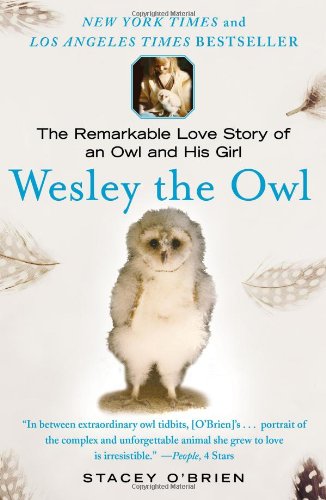
I love animals, so it's appropriate that the first book I blog about be about animals. More specifically, a single animal.
The book is titled "Wesley the Owl" by Stacey O'Brien, and it is possibly the saddest and cutest book I have ever read. In it, Stacey, a biologist, adopts an owl hatchling to raise, consequently falling in love with it. The owl, quite literally, falls in love with her too. It's like Hogwarts and my biology textbook met up and had a love child, complete with 'the power of love' and everything. Except, of course, there's no magic or noseless megalomaniac bald guys who love snakes a little too much.
Stacey O'Brien talks of The Way of the Owl, which entails never breaking promises and loving only one mate per lifetime. Owls become deeply attached to their one mate to the point of willing themselves to die if their mate dies. I find this incredibly moving. It's certain that owls have emotions and souls, as the author says, based on this act alone, but we humans have too much of a superiority complex to consider that the animals we coexist with are just humans with feathers or fur.
But anyways.
I definitely recommend this book. I laughed and cried through most of it, and I guarantee you will too. Unless of course you hate animals, in which case you can redirect to that blog about young adult vampire romance novels which is located in the failsauce portion of the interwebz, kthxbai. Just know that no one I know has ever cried while reading *insert shudder here* Twilight.
Subscribe to:
Posts (Atom)